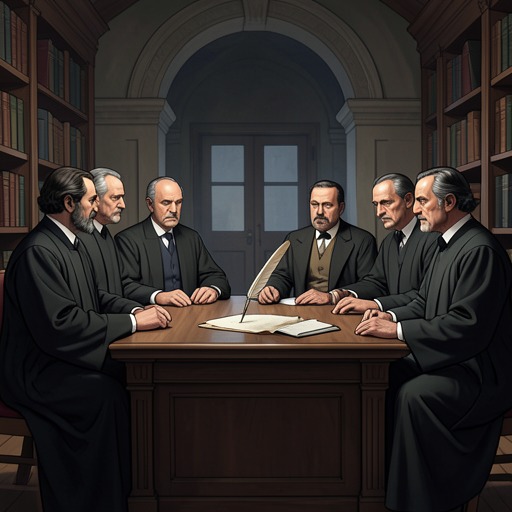
Confederation governance under the Articles
Federalist PapersThe Confederation was a union in which the national government depended on the states to carry out its decisions. In the Federalist essays, that arrangement is not merely an imperfect predecessor to the proposed Constitution: it is the central institutional problem the essays seek to diagnose. Because federal requisitions addressed states collectively rather than citizens directly, compliance could be withheld, national measures could stall, and the remedy for defiance threatened to become force between political communities. The essays connect this structural weakness to public humiliation, uncertain obligations, and the danger of interstate conflict, then defend a stronger national government whose powers would operate within constitutional limits.
Structure and Governing Principle
The essays identify the Confederation’s defining flaw as legislation for states in their corporate capacities, rather than for the individuals who composed them. Congress could call on states for men and money, but lacked authority to raise either through regulations directed to individual citizens. Though its resolutions were constitutionally binding in theory, in practice they amounted to recommendations that each state could observe or disregard at its option.
That distinction, the essays argue, separates a league from a government. A law requires a sanction for disobedience. Courts and ministers of justice can impose penalties on individuals; when authority is directed only at states, however, no judicial process can finally compel compliance. The remaining instrument is military force. In a union of communities, therefore, a breach by a state could turn enforcement into war between parts of the Confederacy. The essays call this arrangement incompatible with effective civil government: it substitutes the coercion of arms for the ordinary administration of law.
The Confederation’s own provisions made the contrast with the proposed Constitution a central point of dispute. The essays acknowledge that Congress could make requisitions to any amount, issue bills of credit, and borrow money, and that it possessed authority to raise troops. Yet those extensive formal powers were rendered ineffective by dependence on the states for their execution. Congress was also a single body holding the federal powers, while the Confederation lacked a bill of rights. The essays use this comparison to argue that the new plan’s powers should be judged against the old system’s combination of concentrated authority on paper and practical incapacity.
Noncompliance and National Crisis
The essays describe the consequences as visible throughout public life. National commitments were repeatedly violated; debts incurred to foreign lenders and American citizens during the struggle for political existence lacked satisfactory provision for payment; and foreign powers continued to hold valuable territories and important posts that, under express agreements, should have been surrendered. The national government, the essays contend, could neither respond effectively to those injuries nor remonstrate with full dignity while its own obligations remained unfulfilled.
Other examples broaden the diagnosis beyond diplomacy. Spain excluded Americans from navigation of the Mississippi, public credit appeared nearly irretrievable, and commerce had fallen to a low point. The essays portray American representatives abroad as lacking the authority that would make them effective negotiators. They summarize the national predicament as one without adequate troops, treasury, or government, and describe the accumulated defects as having become a matter of public experience rather than speculation.
The failure developed incrementally. Under the Confederation, thirteen distinct sovereign wills had to concur in the complete execution of every important measure from the Union. Unequal compliance gave more delinquent states an example and a justification for others: states questioned why they should bear more than their share of a common burden. Each could then yield to immediate interest or convenience, withdrawing support until the machinery of national government nearly stopped. Congress, the essays report, scarcely possessed the means to maintain even the forms of administration while the states considered a more substantial substitute.
The authors reject the hope that a shared sense of interest would reliably overcome these incentives. State administrations, they argue, would assess national measures through local aims and short-term convenience, often without adequate knowledge of national circumstances. Separate assemblies deliberating at different times and under different impressions could not be expected to sustain coordinated action. The result was not a single, sudden collapse, but a feedback loop: noncompliance weakened common administration, unequal burdens encouraged further withdrawal, and declining capacity made the next collective measure harder to execute.
Interstate Disputes and the Threat of Force
The weakness of common authority also endangered peace among the states. The essays point to the dispute between Connecticut and Pennsylvania over land at Wyoming. Under the Confederation, the parties submitted their case to a federal court, which decided in favor of Pennsylvania. Connecticut remained dissatisfied and did not appear fully reconciled until negotiation and management produced something like an equivalent for the loss it believed it had suffered. The account expressly withholds censure: a state, like an individual, may be reluctant to accept a decision against its interests.
Western territory presented a still wider field for competing claims. States that had ceded land might seek to reclaim it if the purpose of the cession had ended; other states could argue that a completed grant was irrevocable and that territory secured through the Confederacy’s joint efforts belonged to all. Even agreement that the land was common property would leave states to contest the rule for dividing it. Because each proposed rule would affect opposing interests, peaceful settlement could not be assumed. Without an umpire or common judge capable of enforcing a resolution, the essays warn, the sword might become the arbiter.
A related controversy between New York and the district of Vermont had, the authors say, exposed how close the Confederacy might come to a threat to its peace if a state attempted to assert its rights by force. Opposition came from states with claims and from states without direct interests. The account attributes that resistance to suspicion of New York’s future power and to the interests of influential people in neighboring states who held grants under Vermont’s government; it further notes that some rival claimants appeared more intent on dividing New York than on establishing their own claims. These examples make territorial administration a test of the Confederation’s ability to keep disagreements within a common political framework.
The Case for Constitutional Reform
The essays argue that the solution could not be a national government that remained dependent on state administrations for every important act. If the states were to retain complete independence while the Union claimed a discretionary supervisory authority, the arrangement would be perilous and unworkable; abandoning national government altogether would leave the states as allies whose friendship could turn to rivalry under local jealousies and foreign influence. To preserve a government rather than a mere alliance, federal authority had to extend to citizens, the proper objects of law.
This argument frames the proposed Constitution as an enlargement of principles already present, not simply an unrelated replacement. The essays describe the Confederation’s principles as too weak and confined to meet the demands of government and preserve the Union. They also defend the convention’s departure from the requirement of confirmation by every state legislature: the proposed plan would be confirmed by the people and could take effect upon approval by nine states. In the authors’ account, requiring unanimity would allow the opposition of a small minority to obstruct a measure supported by the overwhelming majority of states and population.
The authority of the convention itself is defended as advisory and recommendatory. Its charge was to devise provisions adequate to the Union’s needs and report them for consideration; its proposed Constitution could have no effect without approval from those to whom it was presented. The essays portray the convention as responding to a recognized crisis and to broad public expectations of reform. They argue that, in a major change of government, strict adherence to procedural form could defeat the people’s right to alter their political arrangements for their safety and happiness. The account thus treats constitutional change as both a response to institutional failure and an act requiring popular approval.
Interpretation, Limits, and Historical Judgment
The defense of a stronger Union does not, in the essays’ account, mean unlimited national authority. The Necessary and Proper Clause is presented as a means to execute powers granted elsewhere in the Constitution; the Supremacy Clause makes supreme only laws made pursuant to that Constitution. A law that exceeded the federal government’s assigned powers would be an usurpation, not a valid exercise of supremacy. The national government must judge its powers in the first instance, the essays argue, while the people who created it remain the ultimate authority to remedy tyranny.
The same interpretive method appears in the treatment of general language and specific provisions. The essays argue that broad terms such as common defense and general welfare must be read alongside enumerated powers that clarify and limit their meaning. They point out that similar language appeared in the Confederation’s own articles; reading it as unlimited authority would imply that the old Congress could legislate in every case, a construction the authors say its critics would not accept. Their reasoning turns on context and structure: general wording cannot be detached from the specific powers that define its reach.
The essays also present experience as a source of constitutional knowledge. When the Articles were submitted for ratification, the state objections and proposed amendments did not identify the fundamental defect that later experience revealed. The failure, in this telling, shows how an institutional flaw can remain obscure until a system is put into operation. The proposed Constitution might contain errors too, but the authors argue that actual trial would be needed to disclose them; meanwhile, the Confederation’s accumulated failures made the risks of leaving the existing system in place immediate and concrete.
Finally, the essays connect constitutional limitation to independent courts. A limited Constitution can preserve restrictions on legislative power only if courts may declare acts contrary to its manifest terms void. The judiciary’s independence is therefore described as essential to maintaining those limits, not as a claim that judges stand above the people. The Confederation serves throughout this argument as both warning and comparison: its ineffective authority demonstrates the cost of a government unable to act, while the proposed Constitution’s enumerated powers and constitutional safeguards are offered as a way to strengthen national capacity without converting that capacity into unchecked rule.